
Did you know batteries are sensitive to temperature?
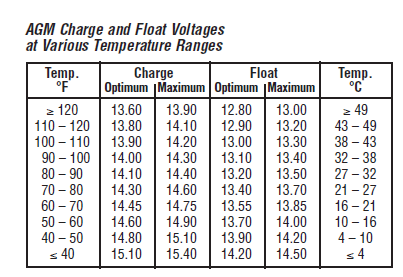
Lead-acid batteries can easily be overcharged if they get hot, or undercharged if they’re cold. While some cold doesn’t sound bad right now – we had intense heat blanketing parts of the northern hemisphere the last few weeks – now seems like a good time to take a look at temperature compensation for batteries. As temperatures fluctuate, so too does the optimum charge voltage.
Temperature compensation is the adjustment of charge voltages based on the temperature of the battery. Note that temperature compensation is specifically for lead-acid batteries (flooded, VRLA, sealed, AGM, Gel, TPPL, etc). Colder lead-acid batteries need higher charge voltages, and warmer batteries need lower charging voltages. This is usually built around a standard temperature of 25C/77F, considered an “optimum” temperature for lead-acid batteries.
Lithium-ion batteries (LiFePO4) don’t require voltage adjustments, but they do have specific temperature limits for charging and discharging which must be followed.
Why?
With lead-acid batteries, cooler temperatures cause ions to move slower, which raises the internal resistance. The energy stored inside the battery may be the same, but it is more work to extract the power from the battery – resulting in a loss of usable capacity and often some amount of voltage drop when a load is applied. Because of the higher internal resistance, a higher charge voltage is needed to charge the batteries.
When lead-acid batteries are warmer, the internal resistance decreases, and ions move more freely. Because of this decreased internal resistance, a lower charge voltage is needed to charge the batteries. A charger can easily deliver too much power into the battery at higher temperatures. The heat can start gassing off the electrolyte (which can be dangerous), and also causes wear on the internal components of the battery. Continued charging at higher voltages can continue to increase the battery temperature, in a positive feedback loop that could potentially lead to thermal runaway.
In any case, the more powerful the charger, the more critical it is that it utilizes temperature compensation.
Beyond affecting charge voltages, temperature also affects the capacity of the batteries. Higher temperatures can increase the available capacity (due to the lower internal resistance), while lower temperatures decrease the usable capacity.
The Temperature Coefficient:
Hopefully your battery manufacturer has a listed temperature coefficient (or temperature factor) for your batteries – the formula for figuring out temperature compensation. Typically this is shown as mV/°C: millivolts per degree Celsius. For example, you may see -24mV/°C, or -0.024V/°C, which is a common temperature factor. In Fahrenheit, it is -13mV/°F, or -0.013mV/°F.
If you cannot find a temperature factor from the battery manufacturer, use 24mV/C° (or 13mV/F°) for temperature compensation for a 12V battery & 48mV for a 24V battery. These numbers are almost always standard for 12v unless otherwise stated, so be sure to double your temperature factor (-48mV/°C) for a 24v system.
The temperature compensation should be zero at an ambient temperature of 25°C/77°F. This means that for every degree the battery is ABOVE 25°C, the charge V should be reduced by 24mV. For every degree that the battery is BELOW 25°C, the charge voltage should be increased by 24mV.
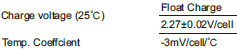
Note:you may also see the factor written as mv/°C/cell – which will be a much lower number. This is for each cell – not an entire 12v battery. A 12v lead-acid battery has 6 cells, so you would multiply that number by 6 for a 12v system, 12 for a 24v system, and so on.
Examples:
Warmer than 25°C:
If you had a 12v battery with a recommended charge voltage of 14.6v and a temperature factor of -24mv/°C (or 0.024v/°C), and the battery was 38°C, what voltage should we be charging at?
38°C – 25°C = 13°C
-24mv x 13°C = -312mv
So the battery should be charging at 14.29v at 38°C.
That’s quite a bit lower than 14.6v, though it may not seem like it. With enough current and time, a charge at 14.6v could evaporate all the electrolyte out. Not only that, but when the charge is applied, the battery temperature will likely continue to rise, needing an even lower voltage.
Colder than 25°C:
Using the same battery example from above (-24mv/°C, 14.6v bulk target), what voltage should we charge a battery at 5°C?
5°C – 25°C = -20°C
-24mV x -20°C = 480mv
So the battery should be charging at 15.08v at 5°C.
Sometimes, as temperatures drop and chargers compensate for lower temperatures, you may see a voltage that looks alarmingly high (or hear a high voltage alarm), but could be within range.
Temperature Compensation on Chargers
Not interested in changing your charger’s target voltages all the time? The good news is that a decent charger should be capable of temperature compensated charging already. In some cases it may need to be enabled, in other cases it can be adjusted via programming to get the right temperature factor. If your chargers can’t properly compensate for temperature, you may be damaging your batteries without knowing it.
Again, the more powerful the charger, the more critical accurate temperature compensation is.
It’s often assumed that the ambient temperature is the temperature of the battery, so many chargers use ambient temperature. This is fine in most situations, and better than nothing in every situation. But it isn’t always possible to get the chargers in the same room as the batteries, so an ambient reading is not ideal. Add in heavy cycling and fast charging, and the batteries themselves can be significantly warmer than the ambient temperature. For this reason, an external temperature sensor that mounts to the side of the battery or onto one of the posts can offer much more accurate readings and better temperature compensation accuracy.
Quality high-powered chargers like the Victron MultiPlus Inverter/Charger come with an external temperature sensor which can be applied to the battery, or it can receive battery temperature through system networking and a compatible device.
Newer advanced alternator regulators often come with a battery temperature sensor as part of the harness, and the temperature coefficient can be programmed and adjusted.
Many chargers are also capable of decreasing the charge current as the batteries approach an upper temperature limit.
The typically lower-powered Victron MPPT Solar Controllers do not come with an external temp sensor and rely on ambient temperature. However, a bluetooth product called the Victron Smart Battery Sense can be connected to the batteries and configured to send battery temperature and voltage to the MPPT solar controllers (as well as many other chargers and devices). An added benefit is that the chargers can use this data to compensate for voltage drop as well.
If you’re looking to upgrade your chargers or batteries, have questions about your system, or want a dialed-in energy upgrade that can handle the heat of summer and keep you cool, contact OPE. Also, if you have additional thoughts or comments on temperature compensated charging, feel free to reach out!
Thanks for reading –
Kevin and OPE
Leave a Reply